




Free policy review & advisory consultation available
Independent Advisory · Faridabad & NCR

Insurance Awareness
& Practical Insights

Most insurance decisions are made with incomplete information. This resource is for individuals, families, and business owners across Faridabad and the NCR region who want to understand health insurance, personal risk protection, and policy review — before making decisions that matter.

No selling. No pressure. Just clarity.

Professional insurance advisory consultation
15+
Years of advisory experience

What Most People Discover Too Late

Insurance is not something people think about daily — until a claim arises. By then, the fine print becomes the main print.

Policy Terms Matter More Than Policy Names

The insurer's name on the cover provides no protection. What protects you is what the policy actually covers — and what it excludes. Most policyholders have never read beyond the summary sheet.

Cheapest Plans Can Become Costly Mistakes

A low premium often reflects lower coverage, higher co-pays, room rent limits, or extensive sub-limits. The real cost appears only when you file a claim — sometimes years later.

Existing Coverage May Be Inadequate

A policy purchased five years ago may no longer match your current family size, health profile, or income. Healthcare inflation in India has been consistently outpacing general inflation.

Protection Gaps Remain Invisible Until Crisis

Income protection, accident disability cover, and business asset insurance are frequently overlooked. These gaps only become visible when a health emergency, disability, or business loss strikes.

What You Should Know Before Deciding

Structured guidance across the areas where clarity matters most — health insurance, policy review, business protection, and personal risk.

Health Insurance

Health Insurance Fundamentals

Coverage decisions affect your family's financial security for years. These topics help you choose with clarity, not just convenience.

HEALTH · 03

Waiting Periods Explained Clearly

Initial waiting periods, PED waiting periods, and specific illness waiting periods are among the most overlooked terms — until a claim is denied in year one.

Ask a Question
HEALTH · 04

Co-Pay, Room Rent Limits & Hidden Restrictions

Room rent sub-limits cascade into linked charges — ICU, doctor fees, nursing. What appears as a minor restriction can significantly reduce the effective coverage at claim time.

Ask a Question
HEALTH · 06

Top-Up vs Super Top-Up Plans

A Top-Up plan activates per claim beyond the threshold. A Super Top-Up aggregates all claims in a year. The difference determines whether a top-up actually adds meaningful protection.

Ask a Question

Policy Review

Reviewing an Existing Policy

Many people renew policies for years without asking whether those policies still serve their needs. A structured review can change that.

REVIEW · 01

How to Review an Existing Insurance Policy Properly

A proper policy review goes beyond checking premium and sum insured. It examines coverage adequacy, exclusion clauses, renewal terms, and whether the product category itself still fits your life stage.

Discuss Review
REVIEW · 02

Signs Your Current Policy May No Longer Fit

A marriage, new child, ageing parent, career change, or significant income shift can mean your existing policy is now misaligned with your actual risk profile and financial exposure.

Discuss Review
REVIEW · 03

Common Reasons Coverage Gaps Are Discovered Too Late

From non-disclosure at inception to outdated nominations, from lapsed riders to insufficient sum insured — the gaps that hurt families most are the ones that feel small until they are not.

Discuss Review

Business Protection

Protecting a Business — What Most Owners Miss

Shops, offices, clinics, and small businesses carry financial risks that health or life insurance does not address. Business insurance is a separate and often overlooked category.

BUSINESS · 01

Do Small Shops and Offices Need Business Insurance?

Sole proprietors and small business owners often assume their scale exempts them from insurance needs. A single fire, burglary, or equipment failure can contradict that assumption significantly.

Discuss Business Risk
BUSINESS · 02

What Business Insurance Covers — And What It Doesn't

Business insurance is not one product. It encompasses fire cover, burglary, third-party liability, machinery breakdown, and more. Each has its own scope, conditions, and exclusions.

Discuss Business Risk
BUSINESS · 03

Fire, Burglary, Stock & Equipment Risk Basics

Understanding what constitutes an insured event — and what documentation is needed at claim time — is something most business owners only think about after a loss has already occurred.

Discuss Business Risk

Personal Risk Protection

Personal Risk Protection — Often Ignored

What happens to a family's finances if the earning member cannot work? This is a question that feels abstract until it becomes urgent.

PERSONAL · 01

Health Insurance vs Personal Accident Cover

Health insurance covers hospitalisation costs. Personal accident cover addresses income loss, disability, and accidental death. These are complementary products — not alternatives to each other.

Learn More
PERSONAL · 02

What Happens If Income Stops After Disability?

Partial or total permanent disability is among the most financially disruptive events a household can face. Most families are significantly underprotected against this specific risk.

Learn More
PERSONAL · 03

Why Personal Risk Protection Is Commonly Ignored

It does not feel urgent because the risk feels distant. The premium feels like a cost rather than protection. These are the exact conditions that leave families financially exposed at the wrong moment.

Learn More

Frequently Asked Insurance Questions

These are the questions that come up most often — from families in Faridabad, salaried professionals, and business owners across the NCR region.

Co-pay is the percentage of each claim that you, the policyholder, bear out of pocket — regardless of the sum insured. For example, a 20% co-pay on a ₹2 lakh bill means you pay ₹40,000. Co-pay is common in senior citizen plans, government employee plans, and some low-premium products. Understanding whether your policy has a co-pay clause — and its percentage — is essential before relying on a plan for a major hospitalisation.

Claim rejection typically happens due to: non-disclosure of pre-existing conditions at the time of purchase, hospitalisation during the initial waiting period, treatment for specifically excluded conditions, insufficient documentation, or hospitalisation that does not meet the 24-hour requirement. Many rejections are avoidable with proper policy selection and honest disclosure from the outset.

Employer-provided group health insurance is a benefit, not a substitute for personal coverage. It typically ends the day employment ends, may not cover your parents, may carry sub-limits, and offers no continuity benefit on pre-existing condition waiting periods. Depending exclusively on employer insurance leaves you financially exposed during job transitions, layoffs, or retirement.

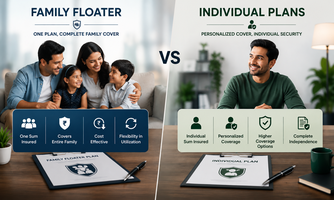
A family floater is cost-effective when members are young and healthy and no single member is likely to exhaust the entire sum insured in one year. Individual plans make more sense when members have distinct risk profiles, when senior members are included, or when the family has a history of significant health claims. The right structure depends on age spread, health status, and affordability — not just premium comparison.

There is no universal answer, but a practical starting point for a family of three or four in Faridabad or the NCR region is a base floater of ₹5–10 lakhs, supplemented by a super top-up plan to extend coverage to ₹25–30 lakhs at significantly lower incremental cost. Healthcare costs at private hospitals in Delhi-NCR can reach ₹8–15 lakhs for complex cardiac or oncological procedures. Adequacy depends on your hospital preferences, age of members, and existing coverage.

Waiting periods are durations during which certain claims are not payable. The three primary types are: the initial waiting period (typically 30 days, during which no claims other than accidents are covered), the pre-existing disease waiting period (usually 2–4 years before PED claims are covered), and the specific illness waiting period (1–2 years for conditions like hernia, cataract, or joint replacement). Buying early — when you are young and healthy — reduces the practical impact of waiting periods significantly.

Yes — they serve fundamentally different purposes. Health insurance covers hospitalisation expenses. Personal accident cover provides a lump sum on accidental death, compensates for temporary disability through weekly benefits, and provides for permanent partial or total disability through capital sums. A salaried individual who becomes permanently disabled but survives the accident needs income replacement — not just medical reimbursement. Personal accident cover addresses this gap at relatively low cost.

Absolutely. A policy taken five to eight years ago may have a sum insured that no longer reflects current hospitalisation costs, coverage terms that have become restrictive relative to newer products, or exclusions that now represent active risks in your family's health profile. Regular review — at least once every two to three years — is not an upselling tactic. It is good financial hygiene.

If a business has physical premises, stock, equipment, or employees, it carries insurable risks. A fire, burglary, or flood does not differentiate between a large company and a small shop. Business insurance — including fire and burglary cover for stock and assets — is available at reasonable premiums for small establishments. The cost of not having it becomes apparent only after a loss event.

Before renewal, check: whether the sum insured still reflects your family's actual hospitalisation cost exposure; whether any member's health status has changed and needs to be declared; whether your TPA network includes your preferred hospitals; whether the insurer has introduced new sub-limits or co-pay clauses in revised terms; and whether a better-structured product now exists at a similar premium. Renewal is not just a payment — it is an annual decision point.

Common Insurance Decision Mistakes

These patterns appear repeatedly across policy reviews. Recognising them is the first step to avoiding them.

01

Buying Solely on the Basis of Premium

Comparing policies by premium alone ignores sum insured, sub-limits, exclusions, claim settlement ratio, and network hospital quality. The lowest premium often signals the most restricted coverage.

02

Not Reading — or Ignoring — Policy Exclusions

Exclusions define what the policy will not pay for. They are not fine print — they are core terms. Maternity, specific procedures, and pre-existing diseases are commonly excluded in ways that only become visible at claim time.

03

Never Reviewing a Policy After Purchase

Insurance is not a static purchase. A policy taken a decade ago reflects a decade-old life situation. Annual renewal without review means silently accepting coverage misalignment year after year.

04

Assuming Employer Cover Eliminates Personal Insurance Need

Group cover is employment-linked. Resignation, retrenchment, or retirement removes it immediately. Buying personal coverage while under group cover is protection continuity — not a duplicate expense.

05

Underinsuring Business Assets

Business owners frequently insure stock and equipment at book value rather than replacement value. At claim time, the difference between what is insured and what it costs to replace is borne entirely by the owner.

06

Ignoring Accident and Disability Exposure

For salaried professionals and self-employed individuals, income continuity is the central financial asset. Personal accident and disability cover protects this asset. Most people insure their health but not their income.

Insurance policy review and advisory
Why a policy review matters A structured review by an independent advisor identifies specific gaps in your current coverage — without any obligation to change or purchase.

Practical Reads for Better Decisions

Focused, actionable insurance reading for individuals and families.

Schedule a Discussion
Health insurance checklist Health Insurance

7 Things to Check Before Buying Health Insurance

Most health insurance comparisons stop at premium and sum insured. These seven factors often determine whether coverage holds up when it matters most.

Discuss With Advisor

Insurance claim process Claims

Hidden Reasons Insurance Claims Get Delayed

Delays in claim settlement are rarely random. Understanding the documentation requirements, TPA processes, and common procedural gaps can significantly reduce claim turnaround time.

Discuss With Advisor
Family health insurance planning Family Planning

Family Floater vs Individual Plans: A Practical Comparison

When does a floater make sense, and when do individual plans provide better protection? The answer is rarely obvious from the premium sheet alone.

Discuss With Advisor
Personal risk protection Personal Risk

Personal Risk Protection: The Coverage Most People Skip

Income is the most valuable asset most working individuals possess. Understanding how personal accident and disability coverage protects that asset is overlooked in most insurance conversations.

Discuss With Advisor
Small business insurance Business

Small Business Insurance Mistakes That Cost Owners Dearly

From underinsuring stock to ignoring third-party liability, small business owners in Faridabad and the NCR frequently discover protection gaps only after an incident has already occurred.

Discuss With Advisor
Policy Review

A Practical Policy Review Checklist Before Renewal

Renewal is an annual opportunity to reassess whether your coverage still reflects your life. This structured checklist guides what to look for — beyond simply paying the next premium.

Discuss With Advisor
Professional insurance advisory for families and businesses in Faridabad NCR
Faridabad & NCR Region

Advisory Built Around
Real Local Context

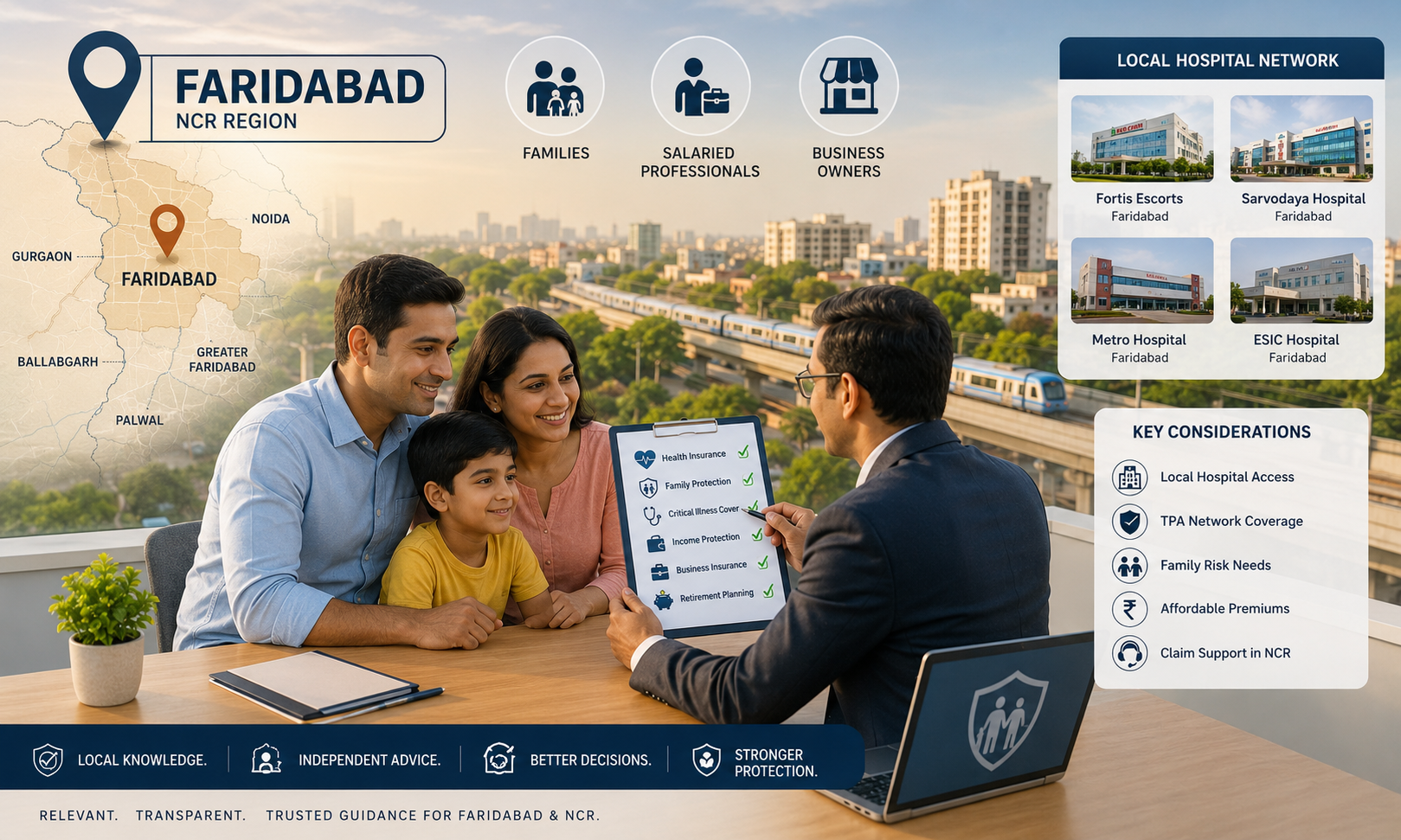
Insurance decisions in Faridabad are shaped by local factors — the hospital network across Sector 16, NIT, and the Neelam Chowk corridor, TPA coverage at Fortis, Sarvodaya, Metro, and ESIC; and the specific risk profiles of families, salaried professionals, and business owners in the NCR region.

This awareness resource is not generic insurance content. It is designed to be relevant and actionable for individuals and families in Faridabad and across the broader NCR — Gurgaon, Noida, Ballabgarh, Palwal, and Greater Faridabad — who want to make better insurance decisions with independent guidance.

IRDAI
Certified Independent Advisor
NIA
New India Assurance Partner
NCR
Region Service Area
Free
Policy Review & Advisory
Independent · Unbiased · Faridabad

Awareness Helps.
Personal Decisions Need Context.

Reading about insurance and making the right decision for your specific family, income, health profile, and risk exposure are two different things. A one-on-one conversation — at no cost and with no obligation — can provide the clarity that general articles cannot.

Free policy review available · No selling pressure · IRDAI certified advisor